
Arbitrage in the MachineFi Era
The Perfect Benchmark
Arbitrage is one of the cleanest use cases in trading: buy low in one place, sell high in another.
In theory, it’s simple.
In practice, it’s a race defined by milliseconds.
On Solana, with sub-second block times, arbitrage opportunities can exist for less than a single block. By the time raw logs are parsed and a transaction is signed, the spread is usually long gone.
That’s why arbitrage is the perfect benchmark for testing whether your trading infrastructure is truly machine-native.
Today’s Pipelines are Broken
Most arbitrage bots are built on top of RPC data and fragile execution logic.
The steps usually look like this:
Capture logs from DEX programs like Raydium or Orca
Parse token accounts and normalize decimals
Reconstruct flows across multiple hops
Calculate spread between venues
Build and sign transactions
Submit to RPC and hope it lands before the opportunity closes
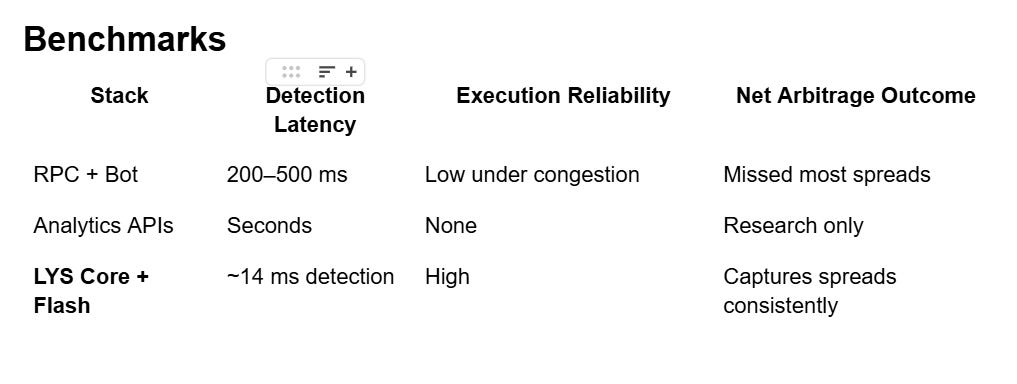
Latency across this stack is typically 200–500 ms.
That’s way too slow for a market where spreads collapse in under 400 ms.
Execution reliability is another issue: during congestion, retries fail, blockhashes expire, and bots spend more time re-signing than trading.
LYS Core: Structured Arbitrage Signals
LYS Core solves the detection problem: instead of raw logs, Core delivers structured arbitrage opportunities as events the moment a block finalizes.
Reconstructed multi-hop swaps: a USDC → SOL → BONK route shows up as one coherent flow, not three separate instructions.
Normalized tokens: decimals, contract IDs, and liquidity pool addresses get resolved.
Wallet clustering: source and destination accounts are clearly linked.
Latency: ~14 ms from block finality.
Instead of wasting cycles cleaning data, arbitrage engines immediately see a ready-to-use event:
“Spread detected: Raydium vs Orca, USDC/SOL, +25 bps.”
LYS Flash: Reliable Settlement
However, detection is only half the loop. The harder part is actually landing the trade.
LYS Flash ensures execution under competitive conditions by:
Prop algorithm: pre-signed trades that remain valid until settlement.
Redundant validator routing: the same transaction is broadcast to multiple leaders at once.
QUIC transport: it uses UDP fast lanes that are prioritized by validators.
Leader awareness: transactions are sent directly to the block leaders that are most likely to confirm them.
In practice, this cuts settlement latency to tens of milliseconds and ensures high confirmation rates even during congestion, with a 90%+ success rate.
Case Study: Cross-DEX Arbitrage
Without LYS:
A bot parses RPC logs from Raydium and Orca.
It takes 300 ms to normalize data and reconstruct flows.
It signs and submits via RPC.
As the transaction fails once, it retries, but the spread closes before the trade is executed.
With LYS Core + Flash:
LYS Core emits structured arbitrage events in 14 ms.
The engine triggers a pre-signed Flash transaction.
The transaction gets sprayed redundantly to multiple leaders over QUIC.
The trade lands in the same block as the spread, successfully capturing it.
What Arbitrage Reveals
Arbitrage is the ultimate pressure test for MachineFi: if your infrastructure can’t capture arbitrage reliably, it won’t scale to more complex strategies.
By combining Core and Flash, LYS closes the loop: signals at block speed, settlement in milliseconds. That’s the foundation of an alpha engine.
In the coming cycle, arbitrage will be dominated by machines running on infrastructure like Core + Flash. The desks that rely on raw feeds and fragile bots will lose: not because their logic is wrong, but because their infrastructure is slow and flawed.
More than just an opportunity, arbitrage is proof that the market is moving machine-first, which is why the Machine OS is becoming a necessity.